Friday, March 1, 2013

Glenn Miller


Happy Birthday, Glen Miller 1904-1944...Glen Miller's reign as the most popular bandleader in the U.S. came somewhat late in his career and lasted a very brief 3 1/2 years, but during that time he dominated popular music and was still selling gold records with reissues of his music 40 years after his death. Miller developed a distinctive sound using a high pitched clarinet playing the melody, doubled by a saxophone section playing an octave lower which produced a series of hits that stand today as definitive examples of swing music. Jazz fans weren't always enthusiastic about his overly rehearsed, highly disciplined band which left no room for spontaneity or improvisation, but Miller himself would say he lead a dance band, not a jazz band.

He got his start in high school with the Boyd Senter band then joined Ben Pollack's band in Los Angeles 1924 after dropping out of collage to become a professional musician. In 1928 he moved to New York, working as a session musician and arranger, joining the Dorsey Brothers Orchestra for a year in 1934 as an arranger and on trombone, moving on to Ray Nobles' band as a player and arranger at the Rainbow Room in Rockefeller Center, at the same time studying theory and composition with Joseph Shillinger.

Miller began recording on his own with pick up bands in 1935, forming his own, not very successful, bands in 1937 and 1938 until he got his big break with an engagement the summer of 1939 at the Glen Island Casino in New Rochelle, New York. Glen Island was a major swing venue with a live radio broadcast giving his band extensive exposure. From that point on the band's popularity soared scoring them 17 Top Ten hits in 1939, 31 Top Ten hits in 1940, 11 in 1941 and 11 in 1942. He also made two films during this period, "Sun Valley Serenade" and "Orchestra Wives".

in 1942, although he was too old for military service, Miller talked his way into a commission with the Army Air Force during WW2. He would go on to create a service band, playing at war-bond rallies and military camps while continuing to do a weekly radio show. He took his band to Great Britain, playing for the troops and doing radio shows then planned to continue on to Paris when his single engine UC-64 Norseman disappeared over the English Channel on December 15, 1944.

Thursday, February 28, 2013

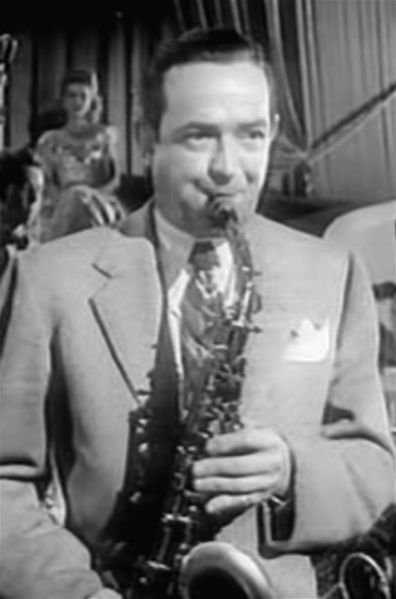
Jimmy Dorsey


Son of a coal miner turned music educator and older brother to Tommy Dorsey, Jimmy Dorsey was a musical child prodigy, playing the trumpet and coronet at local parties with his father at the age of 7. He began his professional career at age 17 playing saxophone with the Jean Goldkette band, then forming "Dorsey's Novelty Six" with his brother Jimmy, one of the first jazz bands to broadcast live. In 1924 he joined the California Ramblers (based in NYC) and continued live broadcasts as well as recording with his brother as session musicians. He joined Ted Lewis' band in 1930, touring Europe with him.

After returning to the U.S. he worked for Rudy Vallee's band as well as his band with his brother. "The Dorsey Brother's Orchestra". In 1935 he broke off to start his own orchestra after a music dispute with his brother. The band became "The Jimmy Dorsey Orchestra" and would feature Bobby Byrne, Ray McKinley along with vocalists Bob Eberly and Kay Weber.

In 1939, Helen O'Connell joined the band and the charming "boy and girl next door" chemistry between her and Eberly produced some of the band's biggest hits. Many of the recordings were done in an unusual a-b-c format with Eberly singing the first minute as a romantic ballard, the next part featured Jimmy backed by the band and the third part was sung by O'Connell in a more upbeat tempo, often in Spanish. It's said this format was encouraged by a record producer who wanted to get both singers and the band on a single 3 minute, 78 recording.

In 1953, a few years after the release of the movie, "The Fabulous Dorseys" the brothers reunited and began playing together again until Tommy's death in 1956. Jimmy took over the band but died shortly after in mid-1957.

Tuesday, February 26, 2013

Betty Hutton


Happy Birthday, Betty Hutton 1921-2007...Singer, dancer and stage, film and television actress, Hutton was described by the NY Times as a, "brassy, energetic performer with a voice that could sound like a fire alarm."

She was raised by a single mother and began singing in the family owned speak-easy at the age of three. As a teenager she sang in local bands and at one point visited New York to try to make it on Broadway but was rejected. She started singing in local clubs in Detroit and was eventually picked up by the Vincent Lopez orchestra which lead to her making some short musical movies in 1939.

She finally made it Broadway in 1940 in "Two for the Show." She signed with Paramount in 1941 where she would make 14 films in 11 years including, "Happy Go Lucky", "Annie Get Your Gun". "Let's Dance" (getting top billing over Fred Astaire) and "Incendiary Blonde".

In 1952, after a contract dispute, she left films for Broadway, nightclubs and concerts. She spent the next 12 years also appearing in television shows like "Gunsmoke" and "Burke's Law". In 1967 her life turned to despair when her mother died in a house fire and she divorced her 4th husband leading her to bankruptcy. Her addiction to pills lead to attempted suicide but she entered rehab and in 1974 she entered Regina University earning a master's degree and an honorary Ph.D. She spent the rest of her life teaching singing and acting at Regina and Boston Universities. Her last public performance was on "Jukebox Saturday Night" on PBS in 1983.

Monday, February 25, 2013

Ida Cox


Happy Birthday, Ida Cox 1886-1967...Cox began her singing career in her local church in Toccoa, Georgia, leaving home in her teens to tour with traveling minstrel shows, often wearing blackface when she performed, eventually headlining at the 81 Theater in Atlanta, Georgia in 1920.

With the advent of Mamie Smith's groundbreaking recording of "Crazy Blues" in 1920, record companies realized there was a demand for "race records" and Ida Cox became part of the classic blues era of female blues singers who ruled in the 20's. From 1923-1929 she made numerous recordings for Paramount Records who heralded her as the Uncrowned Queen of the Blues. She wrote many of her own songs and headlined touring companies through the 30's, sometimes being billed as the "Sepia Mae West". She also headed and managed her own vaudeville troupe, Ida Cox and Her Raisin' Cain Company and Darktown Scandals which criss-crossed the country during the 20's and 30's.

In 1939 she began to perform regularly at Cafe Society in New York and was a member of the cast in the historic Carnegie Hall concert, From Spirituals to Swing which briefly revitalized her recording career. In the mid-40's she had a stroke and retired for awhile from show business. In the late 50's she began performing sporadically and in 1961 she recorded her last album, "Blues for Rampart Street" accompanied by the Coleman Hawkins quintet.

Sunday, February 24, 2013

Jimmy Bertrand


Happy Birthday, Jimmy Bertrand 1900-1960...A jazz and blues percussionist and xylophone player, Bertrand was active on the Chicago scene during the 20's, recording with musicians as diverse as Louis Armstrong, Tampa Red, Ma Rainey, Big Bill Broonzy, Jimmy Blythe and Blind Blake. He came from a musical family in Mississippi with cousins and uncles going on to their own acclaim. His sister was Mable Bertrand, a Chicago showgirl who was married to Jelly Roll Morton from 1928 until his death.

Bertrand got his start with Erskine Tate's band in 1919 and played with him for the next decade. He started his own band, Jimmie Bertrand's Washboard Wizards with Louis Armstrong and Johnny Dodds as members. He kept his own bands going and worked with a few other band leaders through the 40s.

Perhaps his greatest talent was as a teacher. Starting in the 20's, as an instructor of both drums and keyboard percussion, Bertrand helped to focus the talents of several students who would become major figures in jazz including Lionel Hampton and Big Sid Catlett. In interviews, Hampton commonly referred to Bertrand as "my idol". Bertrand retired from music in 1944.


Friday, February 22, 2013

James Reese Europe


Happy Birthday, James Reese Europe 1881-1919...Eubie Blake said of Reese, "He was our benefactor and inspiration. Even more, he was the Martin Luther King of music." Reese earned his praise by being a tireless innovator, not only in his compositions and orchestrations but in his organizational ability and leadership.

Europe got his start in New York in 1904 working as a pianist, quickly making connections in the thriving scene of black theater music. composing and directing for several productions. In 1910 he formed the Clef Club, an organization of over 200 men with it's own orchestra and chorus that also functioned as a union and contracting agency for black musicians. On May 2, 1912, the Clef Club put on an historic "A Concert of Negro Music" in Carnegie Hall to tremendous success. The 125 man orchestra, which included banjos and mandolins, played music solely composed by African-Americans and was the first proto-jazz band to play Carnegie Hall. Reese stood firm to his few critics saying,"We have developed a kind of symphony music that, no matter what else you think, is different and distinctive, and lends itself to the playing of the peculiar compositions of our race. We colored people have our own music that is part of us. It is the product of our souls; it's been created by the sufferings and miseries of our race."

In 1914, with his new Society Orchestra, Reese formed an association with Vernon and Irene Castle, introducing the turkey-trot and fox-trot to American audiences, gaining him national recognition. He also made several recordings for the Victor Record Company at that time including "Castle House Rag" which is included in the National Registry of Recordings.

When WW1 became a reality for Americans, Reese signed up and was commissioned to put together the best band he could muster for the 369th Regiment; the highly acclaimed Harlem Hellfighters, which would take France by storm, traveling over 2,000 miles showcasing it's brilliant and original music to American, British and French troupes and civilians. This would be the first exposure for a European audience to ragtime music and created a huge demand.

Americans took note of Europe's success oversees and he was welcomed home in 1919 as a hero after the war. He became even more determined that, "Negroes should write Negro music. We have our own racial feelings and if we try to copy whites we will make bad copies." He immediately embarked on a tour with his Hellfighters, playing in New York to rave reviews, then moving on to Boston where during intermission, he was stabbed in the neck with a pen knife by one of his drummers in an argument, dying later that night. His tremendous impact on American music was cut short but set the stage for all black musicians and organizers who would come after him.

Thursday, February 21, 2013

Nina Simone


Happy Birthday Nina Simone 1933-2003... Born Eunice Kathleen Waymon in Tryon, North Carolina, Simone showed musical promise when she began learning the piano at age three. She played for her church as a preteen and had her first classical recital in 1945, an event that would also put her on a path toward involvement in the Civil Rights Movement. Her parents sat proudly up front until a white couple arrived and they were asked to move to the back of the auditorium. The 12 year old Simone refused to play until they were reinstated at the front.

After being rejected by the Curtis Institute, Simone move to New York to continue her classical education at Julliard, working at the Midtown Bar and Grill in Atlantic City to pay for her lessons. Singing was required as part of the job and Simone began developing her repertoire of jazz, blues, pop and classical music, gaining a small but devoted following. She began playing in small clubs in New York in 1958 and recorded her only top 40 success in the U.S.that year,"I Loves You Porgy", a song she learned off a Billie Holiday album. Her first album "Little Girl Blue" would follow shortly after.

In 1964 she signed with Dutch Philips which gave her free reign to included songs reflecting her involvement in the Civil Rights Movement. Her recording of "Mississippi Goddamn", done in protest to the church bombing in Birmingham, Alabama and the slaying of Medgar Evers, would signal inclusion of pointed political songs into all of her albums and live performances. She spoke and performed at many civil rights meetings, advocating a violent revolution even though in her autobiography she wrote that she thought all races to be equal.

Simone's singing style and haughty bearing earned her the tile "High Priestess of Soul" but she mellowed in her later years, often engaging with the audience, telling stories from her career and and taking requests. Her early volatile behavior (pulling a gun on more than one person in an argument) was later diagnosed as bi-polar disorder and put under control with medication.

Simone moved to Barbados in 1970 to avoid being arrested for tax evasion (she did not pay to protest the Viet Nam War) and later moved to Europe. As a consequence, American audiences became less familiar with her work even though she recorded frequently through the 80's. That changed in 1987 when there was a resurgence of interest in her music after a Chanel No. 5 commercial in England used her version of "My Baby Just Cares For Me". She was an enormous influence on many pop and jazz artists that came after her, many of them covering her specific renditions of songs. She died at the age of 70 after battling breast cancer for several years.