Friday, March 15, 2013

Harry James


Happy Birthday, Harry James 1916-1983...His exotic beginnings as the child of an acrobat mother and band leader father for the traveling Haag Circus gave Harry James a strong work ethic and sparkling personal charm. He was playing snare drum for the circus at the age of 6 and learning trumpet from his exacting father. The long hours of practice paid off eventually with James becoming one of the most outstanding instrumentalists of the swing era with a distinctive tone and superior technical proficiency. His ability to sight read on the spot earned him the nickname "The Hawk". The joke was that if a fly landed on his sheet music, Harry James would play it.

He began his career in 1931 playing in local bands in Beaumont, Texas at the age of 15. He caught the ear of Ben Pollack and joined his band in 1935 and even auditioned for Lawrence Welk's band but was told he played too loud which was not the Welk style. He headed up Benny Goodman's brass section starting in 1937 but by 1939 wanted to go off on his own. With Goodman's backing, he debuted his own big band, Harry James and His Music Makers in Philadelphia in 1939. He would tour with his band into the 1980's.

James had an ear for talent, finding Frank Sinatra working as a singing waiter and giving him his first big break as well as boosting the careers of other singers such as Dick Haymes, Kitty Kellan, Connie Haines and Helen Forrest. He played in 16 films including "Swing Fever" and "The Benny Goodman Story". Among his many popular recordings were "Ain't She Sweet", "Ciribiriban", "You Made Me Love You" and " I've Heard That Song Before", featured prominently in Woody Allen's film "Hannah and Her Sisters".

He was married three times-once to Betty Grable-and owned several race winning thoroughbred racehorses. He played his last concert with his band in Los Angeles in 1983, just nine days before his death from lymphatic cancer.


Thursday, March 14, 2013

Les Brown


Happy Birthday, Les Brown 1912-2001...Bandleader, saxophonist, clarinetist and composer, Brown was best known for leading his big band Les Brown and his Band of Renown for nearly 70 years. He got his start as a student at Duke University with his group Les Brown and his Blue Devils playing on campus and touring in the summer up and down the east coast in 1936. While some students returned to continue their education, a few stayed on and would continue to tour becoming the Band of Renown in 1938.

RCA-Victor Records helped him get an engagement at the Edison Hotel in New York and in 1940 he played the New York's World's Fair, adding a young Doris Day as vocalist. At the end of WW2 in 1945 he released "Sentimental Journey" putting Doris Day on the map and becoming the unofficial homecoming theme for many returning from the war. Some of the 10 number one hits recorded by the band were "I've Got My Love To Keep Me Warm", "Mexican Hat Dance", "A Good Man Is Hard To Find" and "Leap Frog".

The band also appeared in shorts and feature films including "Seven Day's Leave", "Rock-A-Billy Baby" and "The Nutty Professor" with Jerry Lewis. They performed with Bob Hope on radio, stage and television for almost 50 years and Tony Bennett, who was "discovered" by Hope, made his first public appearance with the band. The band did 18 USO tours for American troupes around the world and were the house band for the Steve Allen Show (1959-1961) and The Dean Martin Variety Show (1965-1972) giving them the opportunity to play with nearly every major performer of their time.

Les Brown, Jr. took over the band after his father's death in 2001. They continue to perform throughout the world and have a regular big band show in Branson, Missouri.


Wednesday, March 13, 2013

Ina Ray Hutton


Happy Birthday Ina Ray Hutton (nee Odessa Cowan) 1916-1984...Hutton lead the Melodears, one of the first all-female swing bands to be recorded and filmed and headed up other bands as well from the 1930's to the 1960's. She passed as white throughout her musical career but when she was a child her family was listed as colored and mulatto by the U.S. Census Bureau when they were using those terms. Hutton was lauded by the local African-American newspaper of her South Side Chicago neighborhood for her dance performances but by the time she was in her teens mention of her disappeared. Some accounts point to the fact that at that time she was discovered by a white vaudeville producer and her career took a more professional turn.

In 1930, Hutton made her Broadway debut with Gus Edwards at the Palace Theater in N.Y. As Ina Ray at age 16, she was a featured singer and dancer in George White's "Melody" and at 17 she joined the Ziegfeld Follies. When she was just 18, the manager Irving Mills put together an all-female band and made her the leader. Mills changed her last name to Hutton at that time to take advantage of the popularity of millionairess Barbara Hutton. The band was called Ina Ray Hutton and her Melodears.

The band toured for five years and Hutton acquired the nickname "The Blonde Bombshell of Rhythm" for her sexy, energetic conducting style and her frequent costume changes (all of them slinky, strappy gowns). Hutton and her Melodears were subjects of several shorts filmed for Paramount including "Accent on Girls" and "Swing Hutton Swing" and also appeared in some feature length films. The group disbanded in 1939.

In 1940 Hutton went brunette and headed up an all-male band which also appeared in feature films and toured until 1946. In the 1950's the all-female format was still popular and Hutton put together another band for television, including her own Emmy award winning Ina Ray Hutton Show. The show aired on the West Coast for 4 years and for one summer season on NBC. She continued to sing and lead bands until her retirement in 1968.


Tuesday, March 12, 2013

The Savoy Ballroom


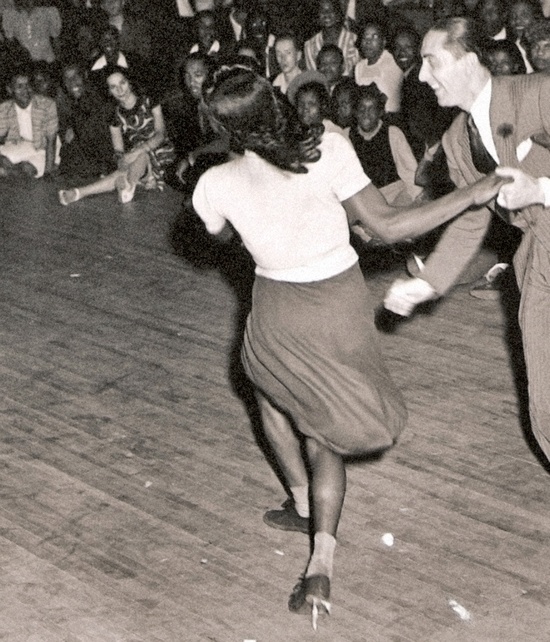
On March 12, 1926 the legendary Savoy Ballroom opened it's doors for the first time. Located at 596 Lenox Ave between 140th and 141st Streets in Harlem, New York, the ballroom took up one city block and could accommodate 4,000 people with two band stands, a pink interior, carpeted lounges, mirrored walls, colored lights and a spring loaded dance floor. During a year's time over 70,000 people would visit making an annual profit of $250,000 in it's peak years when admission was from 30 to 85 cents. The dance floor would have to be replaced every three years from the constant beatings from "Happy Feet". There were 90 permanent employees ranging from musicians, waiters, cashiers, administrative assistants and porters to tuxedo wearing bouncers and hostesses who would show you the latest dance steps.

The owners were white entrepreneurs Jay Faggen and a reputed gangster, Moe Gale and it was managed by African-American real estate businessman Charles Buchanon. Unlike many ballrooms of that era, the Savoy had a no-discrimination policy. On any given night the black/white ratio could be from 85% black/15% white to 50/50. People were judged by how well they danced and not by the color of their skin, a remarkable thing in pre-civil rights times.

The Savoy was the birthplace of the Lindy Hop (among many dance fads) and the northeast corner of the dance floor was dominated by the best dancers. To the people downtown it was known as the "Home of Happy Feet" but to the dancers of Harlem it was known as "The Track" because of the dance floor's elongated shape. It was the home of Whitey's Lindy Hoppers, the most celebrated dancers of the era, many of whom went on to professional careers on Broadway and in Hollywood.

Over 250 name and and lesser known bands played at the Savoy with house bands that included those lead by Fess Williams, Chick Web, Erskin Hawkins and Al Cooper's Savoy Sultans. The double band stand allowed for seamless, continuous music as one band took up where the other band left off. A huge draw was the "Battle of the Bands", the most famous being between Chick Webb's house band and Benny Goodman's band when they were both at their peak of popularity (Webb won).

The Savoy closed it's doors in 1958 and despite efforts to save it and the nearby Cotton Club, it was demolished to make way for a housing project.


Sunday, March 10, 2013

Bix Beiderbecke


Happy Birthday, Bix Beiderbecke 1903-1931...Controversy swirls around some of the facts about Beiderbecke's life but there is no doubt about the influence he had on jazz. Louis Armstrong said about him in 1971, "Every note he blew was so beautiful--I like that "Singing the Blues." Nobody else gonna blow that like he did. I never did play that tune because of Bix. I didn't want nobody to mess with it. Tell the whole world there will never be another Bix Beiderbecke." His purity of tone, unique improvisations, struggles with family and jobs and early death by alcoholism made him one of the early legends of jazz.

As a child in Davenport, Iowa, he showed early promise on the piano. By the age of seven he could play almost anything he heard by ear and by the age of 10 he was slipping away to play the calliope on the excursion boats on the riverfront. When he was 15 his brother brought home a Victrola and several records including "Tiger Rag" by the Original Dixieland Jazz Band and Bix was hooked. He taught himself to play the coronet by ear, adopting a non-standard fingering which some historians connect with his original sound.

When he was 18 he was sent away to boarding school. Until recently the standard take on that action was that his parents disapproved of his playing music, however, it has come to light that he was arrested on a charge of molesting the 5 year old daughter of a neighbor and his family may have sent him away to stay out of controversy. The charge was dropped but his biographer Jean Pierre Lion speculated that the arrest might have led to Beiderbecke feeling, "abandoned and ashamed...and a suspect of perversion." Other biographers and fans dismiss the importance of the event. Nevertheless, boarding school didn't suit him and he was soon thrown out for skipping class to go hear jazz bands and drink.

He joined and recorded with the "hot jazz" Wolverine Orchestra in 1923 and also began taking piano lessons from a young woman who introduced him to the works of Eastwood Lane whose style influenced Beiderbecke's only recorded piano piece "In a Mist." He joined Jean Goldkette's orchestra in 1924 but his "hot jazz" style of improvisation and inability to read music eventually lost him the job. That didn't stop him from recording on his own, putting out "Toddlin Blues" and "Davenport Blues" with members of Goldkette's band.

He joined Frankie Trumbauer's Orchestra in 1925 and for the rest of his career Beiderbecke and Trumbauer remained close, Trumbauer becoming a supporter and father figure to the younger man. It was during this time he recorded his solo masterpiece "In a Mist" as well as some of his best work with Trumbauer and guitarist, Eddie Lang. He brushed up enough on his sight reading to re-join Goldkette's band for another brief stint before signing up as a soloist with Paul Whiteman's Orchestra.

Whiteman's orchestra was the most popular band of the 1920's and Beiderbecke enjoyed the money and prestige of playing for such a successful outfit but it didn't stop his drinking. By 1929 his drinking began to catch up with him. He suffered from delirium tremens and had a nervous breakdown while playing with Whiteman. He was sent back to Davenport to stay with his family and was eventually placed in rehab with Whiteman continuing to pay him full salary with a promise to save his seat in the band for him. Whiteman famously kept his seat empty in Beiderbecke's honor but he never returned to play with the band again.

In 1930 he returned to New York to make a few recordings with his friend Hoagy Carmichael under the name Bix Beiderbecke and his Orchestra. But mainly he stayed in his room in a Queens boarding house drinking a lot and working on three beautiful solo piano pieces he would never record. He died at the age of 28 from an alcoholic seizure.


Saturday, March 9, 2013

Georgia White


Happy Birthday, Georgia White 1903-1980...Her early life is a mystery but by the late 1920's she was singing the blues in Chicago nightclubs. Her first recording "When You're Smiling, the Whole World Smiles with You" was made with Jimmy Noone's orchestra in 1930. Her next foray into the studio began in 1935 for Decca and for the next six years she made over 100 recordings, more than any of her Women of Blues rivals, Lil Johnson, Merline Johnson and Memphis Minnie during that time.

Like many recording artists of the time, she also recorded under a pseudonym, Georgia Lawson. Her songs were often mildly risque with titles such as "I'll Keep Sittin' On It (If I Can't Sell It)", "Hot Nuts", and "I Just Want Your Stingaree" which she recorded with a warm and amused presentation. Her primary accompanists during the Decca recordings were pianist Richard M. Jones and guitarist Lonnie Johnson.

In the 40's she formed an all woman band which never recorded then went on to perform with Bumble Bee Slim and Big Bill Broonzy as his pianist in his Laughing Trio. She returned to performing in clubs in the 1950's with her last known performance in Chicago in 1959.


Friday, March 1, 2013

Glenn Miller


Happy Birthday, Glen Miller 1904-1944...Glen Miller's reign as the most popular bandleader in the U.S. came somewhat late in his career and lasted a very brief 3 1/2 years, but during that time he dominated popular music and was still selling gold records with reissues of his music 40 years after his death. Miller developed a distinctive sound using a high pitched clarinet playing the melody, doubled by a saxophone section playing an octave lower which produced a series of hits that stand today as definitive examples of swing music. Jazz fans weren't always enthusiastic about his overly rehearsed, highly disciplined band which left no room for spontaneity or improvisation, but Miller himself would say he lead a dance band, not a jazz band.

He got his start in high school with the Boyd Senter band then joined Ben Pollack's band in Los Angeles 1924 after dropping out of collage to become a professional musician. In 1928 he moved to New York, working as a session musician and arranger, joining the Dorsey Brothers Orchestra for a year in 1934 as an arranger and on trombone, moving on to Ray Nobles' band as a player and arranger at the Rainbow Room in Rockefeller Center, at the same time studying theory and composition with Joseph Shillinger.

Miller began recording on his own with pick up bands in 1935, forming his own, not very successful, bands in 1937 and 1938 until he got his big break with an engagement the summer of 1939 at the Glen Island Casino in New Rochelle, New York. Glen Island was a major swing venue with a live radio broadcast giving his band extensive exposure. From that point on the band's popularity soared scoring them 17 Top Ten hits in 1939, 31 Top Ten hits in 1940, 11 in 1941 and 11 in 1942. He also made two films during this period, "Sun Valley Serenade" and "Orchestra Wives".

in 1942, although he was too old for military service, Miller talked his way into a commission with the Army Air Force during WW2. He would go on to create a service band, playing at war-bond rallies and military camps while continuing to do a weekly radio show. He took his band to Great Britain, playing for the troops and doing radio shows then planned to continue on to Paris when his single engine UC-64 Norseman disappeared over the English Channel on December 15, 1944.